Humidity, HDB Flats, and Solid Wood Furniture: Why Your Bed Frame, Wardrobe, and Dining Table Behave the Way They Do
I keep a small hygrometer clipped to the inside of my wardrobe door. Last April, during that sticky two weeks between the monsoon surge and the launch of the school holidays, it read 86%. The same afternoon, I visited a friend's new 5-room HDB in Punggol — brand-new BTO, vinyl flooring still smelling of installation — and watched his oak dining table develop a faint crown across the centre that I could feel with the flat of my palm. That single visit is what pushed me to research humidity tolerances for every solid wood piece in my home, from a 1.8-metre bed frame to a slender 45 cm nightstand.
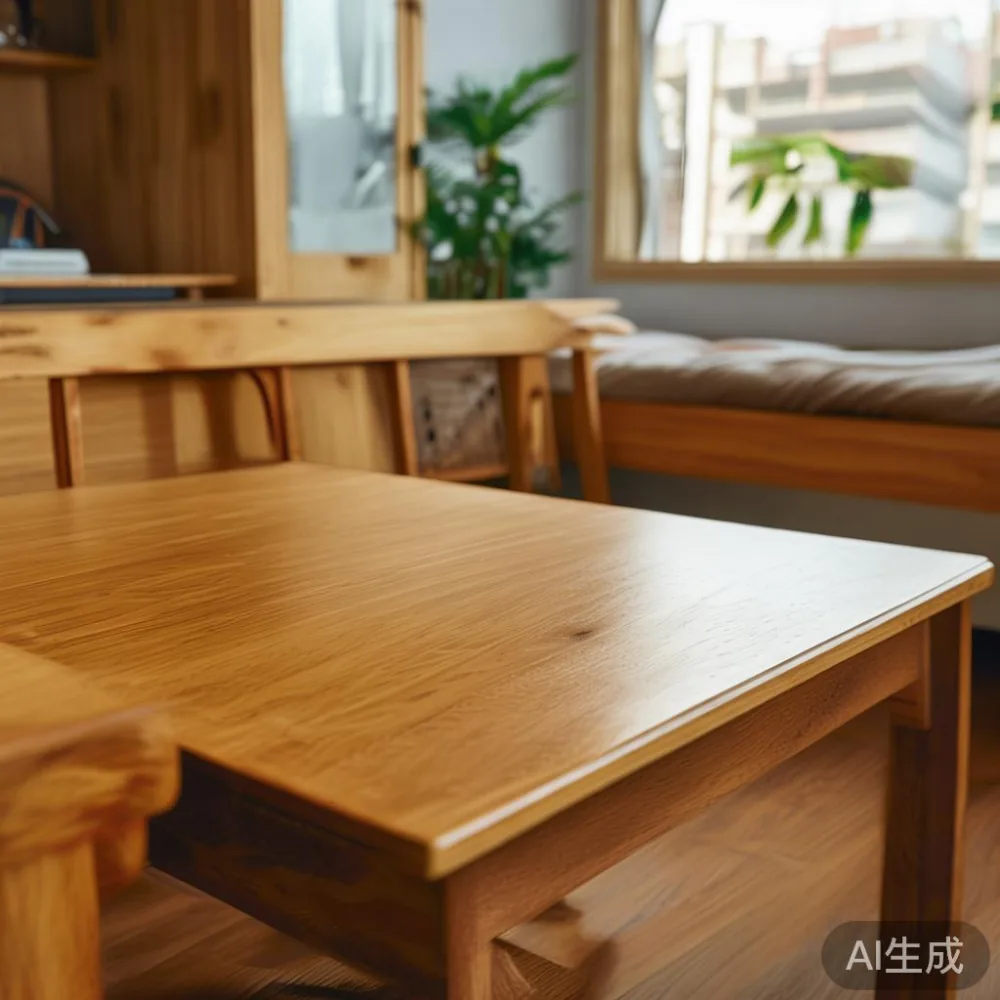
This guide is written for Singapore households, whether you live in a 1960s walk-up in Bendemeer, a 1,200 sqft executive apartment in Tampines, or a 1,400 sqft condo in Bedok. Southeast Asia is one of the more demanding climates on Earth for wooden furniture. Average relative humidity sits between 70% and 85% for most of the year, dipping into the 50s only on the driest January afternoons. Pair that with a 2.4-metre HDB corridor and lift openings that are often 1.1 m wide, and you start to see why material choice, joinery, and finishing matter far more here than in a temperate city like Copenhagen or Munich.
The real numbers behind Singapore's humidity
The Meteorological Service Singapore publishes data that most people never read. The annual mean relative humidity for the city is around 79.2%. Mornings are typically 5–10 percentage points higher than afternoons. In a poorly ventilated HDB kitchen, where windows face the afternoon sun, the air around your cabinetry can climb another 8–12 points. That matters because wood is hygroscopic — it absorbs and releases water vapour from the surrounding air as long as the cell walls are exposed. A solid oak dining table in a Tampines living room is not a static object. It is a slow sponge, constantly moving between roughly 8% and 14% moisture content across the year.
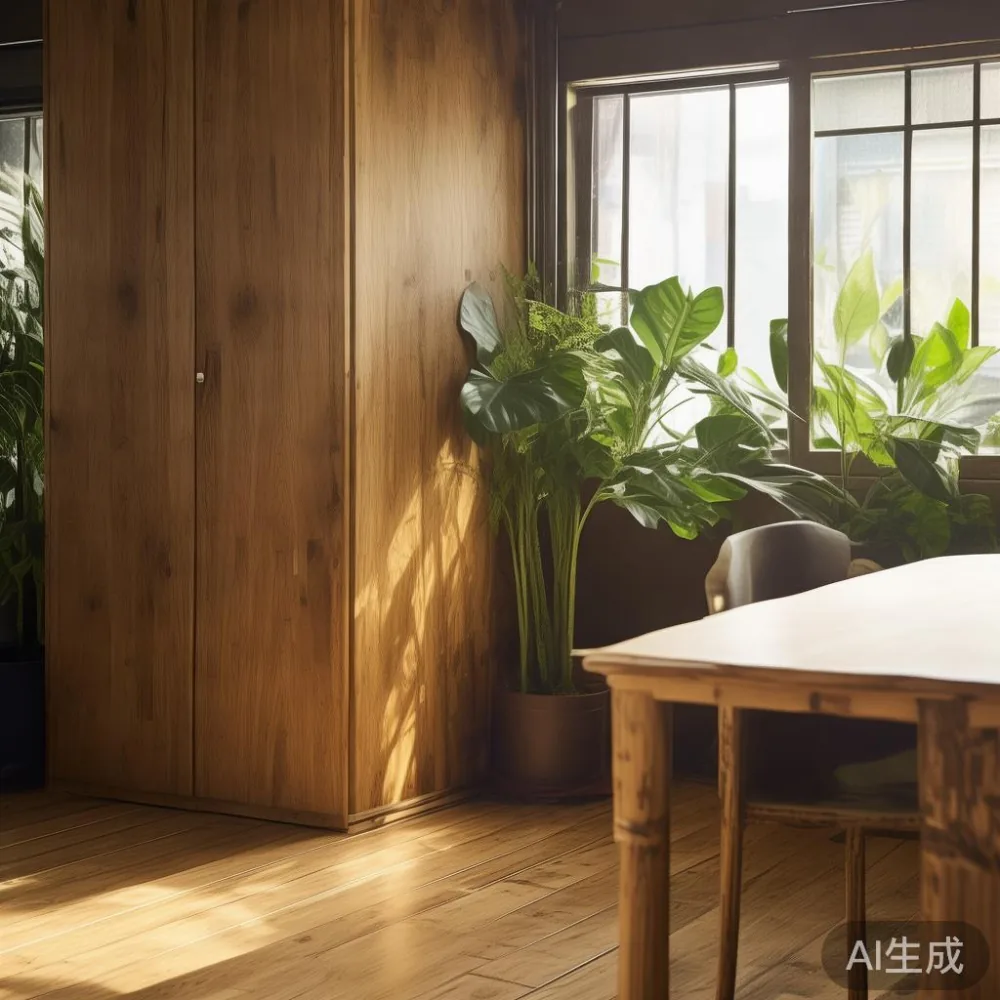
Quarter-sawn white oak moves very little along its width — typically 1.8% tangential, 0.8% radial. Flat-sawn beech, by contrast, can move 4% tangentially. Translated into a real surface, a 1,200 mm-wide oak tabletop can swell 10 mm across the wet season and shrink back during a particularly dry Chinese New Year week when the air-conditioning runs 22 hours a day. That is normal behaviour for solid wood. The same movement in a poorly sealed MDF core can cause a permanent bow.
What actually happens to a bed frame and wardrobe when RH exceeds 80%
Wooden wardrobes are usually the first piece of furniture to reveal climate stress, because three of their four sides are hidden, air circulates poorly, and the panel area is the largest in the bedroom. A 2-metre-tall x 1.2 m-wide three-door wardrobe in solid ash will change its panel width by 6–8 mm across a typical Singapore year. If the carcass is constructed using floating tenons with 4 mm expansion gaps and a proper hardwood back, this movement is accommodated silently. If it is built with glued-and-nailed MDF side panels wrapped in a 0.6 mm veneer, the same movement shows up as edge lift at the corners or hairline splits along the grain.
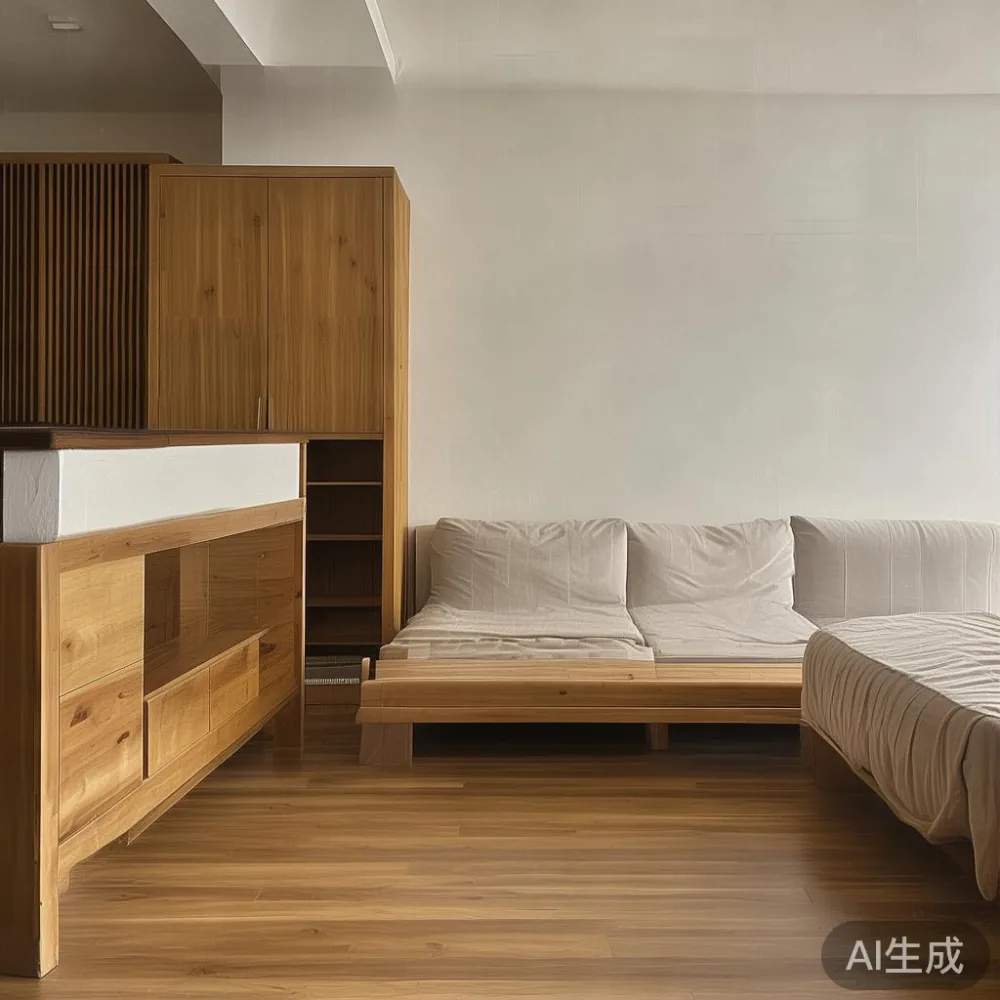
Solid wood bed frames behave more gracefully because the structural members — headboards, side rails, footboards — are usually thicker (35–45 mm) and shorter in the cross-grain direction. A standard Queen bed frame is 152 cm x 191 cm, and 152 mm slat-to-rail contact points give moisture somewhere to travel without visible distortion. This is also why a Scandinavian-style Nordic solid wood bean bag with internal solid oak dowels is a less fussy piece than a tall, narrow bookcase: the geometry of the slab dictates how visible the seasonal shift will be.
How Tampines and Bedok HDB corridors limit your choices
Furniture delivery in Singapore is shaped by hardware that has nothing to do with wood. HDB lifts in the 1970s and 1980s blocks typically offer a 1.0 m x 1.4 m opening with an internal depth of 1.6 m; newer BTOs like those in Punggol North are usually 1.1 m wide x 2.1 m deep. Corridor widths range from 1.2 m to 1.5 m, and the corner at your entrance door is rarely a right angle — most flats have a 90-degree turn within 3 metres. A fully assembled 2.4-metre wardrobe will not physically fit through that geometry. This is why every reputable retailer, MIDHILL among them, quotes piece dimensions for delivery and offers sectional wardrobes that join inside the bedroom.
For pieces that arrive flat-packed, ask whether the carpenter who assembles on site uses a rubber mallet rather than a steel hammer — the latter can dent mortise and tenon joints by 2–3 mm, which during a 90% humidity week becomes 4 mm of uneven shoulder. For marble table tops, the same maths apply: a 140 cm round travertine slab weighs roughly 95 kg with the underframe, while a 180 cm dining table in solid walnut can weigh 110 kg net before protective blankets. Always confirm whether the delivery team uses a four-wheel trolley rated above 150 kg and whether they bring a torque wrench for the bed frame bolts.
Why French light luxury and Scandinavian joinery both survive the monsoon
French light luxury interior schemes often pair travertine or Carrara marble tables with thin-profile walnut or ash casegoods. The aesthetic is restrained — neutral palette, light-shadow contrast, brass hardware in 0.8–1.2 mm gauges. What makes these pieces work in Singapore is structural: the frame-and-panel construction allows the solid wood faces to float on the carcass, and the brass fittings are deliberately over-engineered for the climate. Marble table tops, however, behave differently from wood. They are not hygroscopic on the visible face, but the substrate (often plywood or MDF in light-luxury lines) is. A French light luxury dining table from a careful maker will specify a 14 mm marble top on a marine-grade ply core, with a 3 mm expansion gap on every edge sealed by a flexible neutral silicone.
Scandinavian post-modern light luxury, by contrast, leans on solid ash, beech, and oak with soap or hardwax-oil finishes that allow the wood to breathe. These finishes do not seal out moisture the way a polyurethane coat does — they manage it. The trade-off is that you must re-oil the surface every 12–18 months in Singapore, which is exactly the kind of service model that brands like MIDHILL have built their reputation on. American light luxury trends lean heavier — darker walnut, thicker slab tables, more aggressive grain — but the same solid wood rules apply.
What is the difference between Japandi corner sofa and modern furniture?
A Japandi corner sofa is a hybrid between Japanese minimalism and Scandinavian materiality, combining a low-profile L-shaped silhouette (typical seat height 38–42 cm, total depth 160–185 cm) with solid wood frames in oak or ash, removable linen-blend covers, and cushions filled with feather-and-foam mixes at roughly 70/30 ratios, while modern furniture broadly refers to a post-1950s design vocabulary that can use metal, plywood, plastic, or any upholstery fabric without a fixed joining tradition.
Designing with bamboo furniture in a Singapore HDB
Bamboo furniture deserves its own paragraph in a humidity guide, because bamboo behaves more like a tropical hardwood than like the softwood frames it visually mimics. Properly laminated bamboo panels — those 25 mm thick surfaces you see on dining tables, bed frames, and wardrobe fronts at MIDHILL and a handful of regional workshops — are pressed at 1,400 tonnes of pressure and bonded with phenolic resin, which stabilises the strands to around 6–9% moisture content. That means a bamboo dining table in a Tampines HDB will move less, season to season, than a comparable oak table.
In a 1,200 sqft Tampines four-room flat, three pieces of bamboo furniture handle the climate beautifully: a 1.6 m dining table, a 1.8 x 2.0 m wardrobe with bamboo ply backs, and a bedroom nightstand in solid bamboo. The wardrobe alone absorbs roughly the same humidity as a 35 kg block of air would displace, and because bamboo is naturally high in silica, it resists the soft-rot fungi that occasionally trouble oak wardrobes in poor ventilation.
What Singapore conditions mean for nightstands, wardrobes, and dining tables
Nightstands are the easiest piece to get right and the easiest piece to get wrong. A 45 cm wide x 50 cm tall nightstand in solid cherry will sit between your bed and your wardrobe, and on most nights the only humidity it feels is the localised spike from your bedside lamp and your phone. Insist on a fully dovetailed drawer, with at least 4 mm of seasonal clearance at the drawer front — most Japanese-style nightstands you will see at American light luxury retailers are built that way, and most local knock-down nightstands are not.
For wardrobe interiors, a 24 mm solid bamboo back panel with vertical breathing gaps of 6 mm along the top and bottom is preferable to a thin laminate. Wardrobes left half-open during the day show less stress at the door edge than those kept closed. Dining tables around 1.6–1.8 m in solid oak, on a trestle base with through-tenons, require two minutes of care every six months: a light soap-oil application, no water pooling, no hot pot without a trivet. A 90 cm round dining table for four uses roughly 40% less board surface than a 1.8 m rectangular table, which means 40% less seasonal movement to manage.
Care schedule that an HDB owner can actually keep
Daily: wipe coasters and rings from tabletops within 10 minutes with a dry microfibre cloth. Weekly: open wardrobe doors for 30 minutes to equalise humidity between inside and outside. Quarterly: vacuum wardrobe corners on a low setting to reduce dust accumulation, which traps moisture and stains hardwood. Twice a year: apply hardwax oil to all exposed solid wood surfaces, budget around 350 ml per dining table and 150 ml per nightstand. Once a year: a deep inspection of joints, drawer runners, and door hinges, with a 1 mm hex key to re-seat any loosened stretchers. The total annual cost in Singapore, if you do it yourself with a tin of oil and a microfibre set, is roughly S$45 to S$60. If you commission a service team, expect S$180 to S$280 per visit.
For most Singapore households, the single biggest win comes from running a dehumidifier in the bedroom during peak monsoon months. A 12-litre compressor unit costs S$0.10 to S$0.18 per hour at current electricity tariffs and keeps the wardrobe microclimate at a constant 55% RH, which is a level at which solid wood settles into its narrowest equilibrium band.
Pricing, delivery, and warranty in the local market
Mid-range solid wood furniture from MIDHILL and similar Foshan workshops typically lands in Singapore between S$1,800 and S$4,200 for a standard Queen bed frame, S$2,600 to S$5,500 for a 1.6 m dining table in oak, and S$3,200 to S$6,800 for a 2-metre three-door wardrobe, before GST. Quality bamboo furniture pieces tend to be 12–18% cheaper than comparable oak due to the faster crop cycle of Moso bamboo. Standard delivery for orders above US$350 (roughly S$480) is free, with 14-day returns and a 10-year structural warranty that covers joint failure, warp beyond 4 mm across the tabletop, and drawer-rail defects. Refinishing services for a 1.6 m dining table are typically priced at S$260 to S$420 depending on whether a full sand-back or a fresh coat of oil is required. These margins matter because the cheapest piece on the showroom floor is rarely the cheapest piece to own across an HDB flat's 99-year lease.
A short checklist before you check out
Ask the retailer: which wood species, what thickness of solid face boards, what joint type at the carcass corners, what finish was applied and at what film thickness, what expansion gaps were designed into the panels, what weight per square metre the table top carries, and what the warranty term covers in writing. Compare those answers against a hygrometer reading you take in your own home for a sample week. If the retailer cannot answer in cm, mm, and percentage points, keep looking. Singapore's humidity is constant; your furniture's response to it should be designed, not accidental.