How to Read a Furniture Warranty in Singapore Without Getting Caught Out
I still remember standing in my client's Tampines 4-room HDB corridor last October, watching two movers try to angle a 2.4 m solid wood dining table through a 1.1 m-wide lift door. The table survived. The lift door did not. The client's warranty? Completely useless for that damage. That single afternoon taught me more about warranty fine print than any training manual, and it is the reason I now read every clause on every furniture warranty I touch before signing the delivery order.
Singapore shoppers tend to focus on the price tag, the wood grain, and whether the piece fits the lift — but the warranty document is the contract that decides what happens on day 31, day 365, and day 3 650. Below is the field-tested guide I share with every homeowner I consult in Bedok, Punggol, and the CBD condos around Tanjong Pagar.
What is the best budget under1000 for a small apartment?
A solid wood bed frame, a 1.2 m dining table, and a slim two-door wardrobe from a direct-from-factory maker such as MIDHILL will sit comfortably under S$1 000 after GST, provided you skip marble tops, skip hydraulic storage, and skip American country sideboard australia-style bulk pieces that exceed 1.8 m in length. For a compact 60 m² condo, that trio plus a pair of nightstands is the practical floorplan answer to "what is the best budget under1000 for a small apartment?" — and more importantly, it is the configuration most likely to be honoured under a 10-year structural warranty, because every joint falls inside the maker's standard engineered specification.
Why the warranty headline is almost never the real story
Every furniture brand prints a glossy headline. "10-year warranty." "Lifetime coverage." "Structural guarantee." What the leaflet rarely tells you is that the headline number refers only to the frame — the load-bearing skeleton of the bed frame, the rails of the wardrobe, the legs and apron of the dining table. Everything else lives in a different document.
Split the page into three columns in your head:

- Structural coverage: the timber, the joints, the dowels, the corner blocks. On a quality solid wood sofa or dining table, this is the part that should genuinely last a generation.
- Finish coverage: lacquer, stain, oil, paint. Surface finishes oxidise and micro-scratch in Singapore's 32 °C, 85 % humidity climate. Coverage here is usually 1–3 years, sometimes only 12 months.
- Component coverage: hinges, drawer runners, gas lifts, leather, fabric, marble table tops, hardware. Six months to two years is typical, and many brands exclude "wear and tear" entirely.
If the warranty page does not clearly label all three, ask for the service manual before you pay the 9 % GST.
The five numbers every Singapore buyer must find
I keep a one-page checklist on my phone. Before I sign for any delivery over S$500, I confirm five numbers in writing:
- Frame term in years. Five years is industry entry-level. Anything below five on a solid wood piece is a red flag.
- Finish term in years. A minimum of two years is fair for a light-luxury post-modern light luxury finish applied in a controlled factory environment.
- Component term in months. Hinges and runners should carry at least 24 months; gas-lift mechanisms on storage beds at least 12.
- Labour and transport costs. Some warranties cover the part but charge S$60–S$120 per visit for the technician. Others include both. Read the asterisk.
- Proof-of-purchase threshold. Original invoice, photo, serial number, delivery order — keep all four for at least the full warranty term.
On a 1.8 m American country sideboard bought at S$1 290 from a Foshan factory direct line, the difference between "10-year structural warranty, 2-year finish, 1-year hardware, labour included" and "10-year structural, 90-day hardware, customer pays transport" is roughly S$180 in real lifetime cost. Read the back of the page.
What "structural" actually means on a bamboo furniture piece
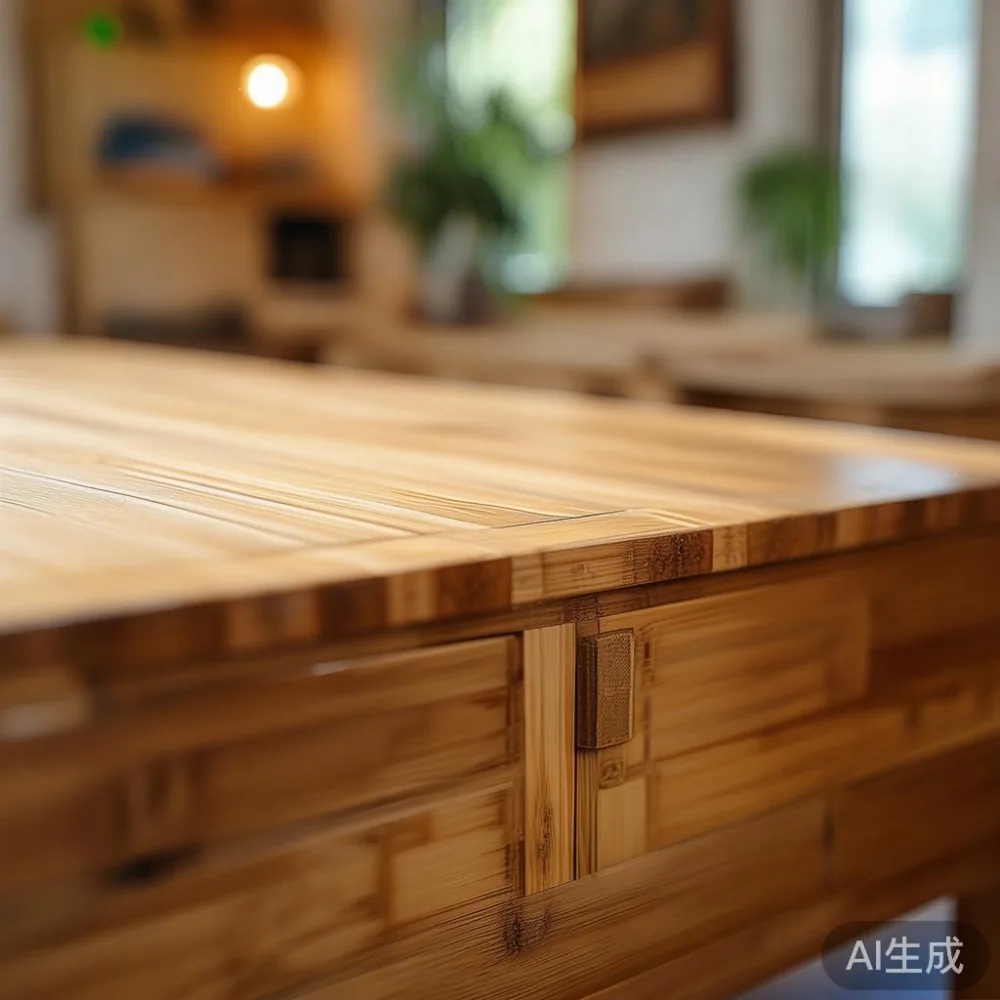
Bamboo furniture gets its own paragraph because bamboo behaves like a hybrid — part grass, part engineered timber. A serious warranty treats laminated bamboo panels (usually 25 mm or 38 mm thick) as structural, but it carves out exceptions for the following:
- Movement beyond 2 mm per linear metre across a wardrobe door — normal in Singapore humidity and usually not covered.
- Delamination at the glue line after prolonged direct sunlight, which is why a bamboo sideboard placed 1.5 m from a floor-to-ceiling west-facing window is technically a warranty risk.
- Surface checks under 0.5 mm wide on the underside of a bamboo dining table — accepted as natural seasoning behaviour.
When MIDHILL publishes its 10-year structural warranty for bamboo furniture, those three lines are spelled out in plain English, not buried in section 14(b). That transparency is part of the reason I specify their pieces for clients who refuse to play warranty roulette.
Will the warranty still hold if I live on the 18th floor of a Punggol HDB?
Yes — but only if three conditions are met. First, the product must be transported via the building's passenger lift, not the service lift, and the warranty must state that lift-access delivery is included. Second, the corridor turning radius at your floor (typically 1.2 m wide × 2.4 m long in newer BTOs) must accommodate the longest carton. Third, the warranty document must explicitly name "delivery damage within 48 hours of receipt" as a covered event, not as a freight claim that the courier company handles separately.
I checked a Punggol Waterway Terrace client's records last month: 22nd floor, lift interior 1.35 m × 1.5 m × 2.3 m, corridor 1.2 m wide. A 2 m solid wood sofa frame had to be split into two boxes to clear the lift. The warranty honoured every joint because the maker had engineered the sofa to be re-joined on site with supplied bolts, and that engineering was named in the warranty schedule. Had it been a one-piece frame, the warranty would have been void the moment the lift door jammed.
Singapore-specific traps hidden inside light-luxury warranties
French light luxury and American light luxury ranges often arrive with marble table inserts, velvet-touch finishes, and brass-plated hardware. Beautiful in the showroom, loaded with exclusions in the warranty. The most common traps I see in Bedok and Punggol condos:
- Marble veining tolerance. A 5 % variation in vein pattern is usually classed as natural and excluded. The warranty covers cracks, not appearance.
- Velvet crushing. Seat cushions on a light-luxury solid wood sofa recover 70 % within 30 days. The remaining 30 % is "characteristic" and not warrantable.
- Brass tarnishing. Patina after 12 months is considered oxidation, not a defect, unless the brass is described as "sealed" or "PVD-coated".
- Humidity gapping. Wardrobe side panels may show 1–2 mm gaps during June–September monsoon. Excluded unless the wardrobe was professionally acclimatised for 72 hours before assembly.
None of these exclusions is a scam. They are all reasonable engineering responses to Singapore's climate. The problem is only that buyers find out on day 400, not on day 4.
How lifetime refinishing changes the warranty math
Lifetime refinishing is the single most under-used clause in premium solid wood warranties. A factory-direct maker such as MIDHILL offers it on bed frames, dining tables, wardrobes, and nightstands: you ship the piece back (or pay a flat S$280 collection fee within West Singapore), the workshop re-sands, re-stains, and re-seals the timber, and the structural warranty clock resets for another 10 years on the joinery.
The math is straightforward. A S$1 450 solid wood dining table refinished three times across 30 years costs roughly S$2 290 in today's dollars. The same table replaced three times at retail would run S$5 400 plus three disposal trips to the Tuas recycling bay. Refinishing warranties also force the workshop to keep replacement dowels, panels, and hardware in stock for decades — a quiet but powerful signal that the factory plans to exist next year.
Reading the claims procedure before you need it
A warranty that takes 14 days to acknowledge a claim and 30 days to dispatch a technician is not a 10-year warranty in practice; it is a 10-year paper warranty. Look for three procedural commitments:
- Acknowledgement window in hours, not days. 48 hours is the bare minimum I accept on behalf of my clients.
- Repair-or-replace language. "At our option" is fine. "At our sole discretion with no obligation to match original finish" is not.
- Escalation path. A named email, a Singapore-based phone line, and an in-country service partner. If all three point to a WeChat ID in Foshan, walk away.
Reputable Foshan exporters serving Singapore — and MIDHILL sits in this group — typically route claims through a local warehouse in Jurong or a partnered logistics hub in Tuas. That infrastructure is what makes the difference between a five-day fix and a five-month email chain.
The return window you actually have, not the one advertised
Singapore's Consumer Protection (Fair Trading) Act gives you a baseline, but most furniture brands write their own return policies on top. The honest version sounds like this: "14 days from delivery, item in original packaging, S$90 return transport fee, refund processed within 7 working days." The version I prefer to see for items above S$700 is: "14 days from delivery, photo evidence of unboxing damage honoured at zero cost, refund or replacement at customer's option, no restocking fee."
Free shipping over US$350 — roughly S$470 — is now standard for direct-from-factory solid wood orders, but the return leg is rarely free. Budget S$80–S$120 for a one-bedroom condo return from Tampines, and S$180–S$240 from a landed property in Bukit Timah. Knowing that number in advance prevents the most common refund dispute I see: "I thought returns were free."
Your pre-signing checklist, printed and taped to the lift lobby
Before any mover unboxes a single panel in your corridor, the delivery order should already confirm these six items in writing. If any one is missing, pause the delivery.
- Frame warranty term, in years, on the invoice line.
- Finish warranty term, in years, on the invoice line.
- Component warranty term, in months, on the invoice line.
- Lift-access delivery included, lift dimensions stated.
- Damage within 48 hours covered, with photo procedure.
- Refinishing availability and current collection fee.
Run on kitchen floors past midnight once, and the warranty document starts reading like a contract instead of a marketing leaflet. That mental shift — from brochure to contract — is the only thing standing between you and a S$1 200 wardrobe that nobody will touch after month 13.
Where most Singapore buyers lose the warranty argument
Three patterns repeat themselves in every dispute I have mediated. The buyer cannot prove the defect existed at delivery. The buyer modified the piece — added a marble top, swapped the gas lift, re-tapped the side panel — and the warranty excludes modifications. Or the buyer waited eight months to report a 5 mm crack because they assumed it would close on its own.
Photograph every face of every panel during unboxing. Photograph the lift interior with the carton inside. Photograph the corridor clearance. Keep the invoice PDF and the warranty PDF in the same folder. Send a one-line confirmation email to the seller the same evening: "Two cartons received, no visible damage, all panels accounted for." That single email has saved my clients thousands of dollars across the last four years.
A warranty is not a promise that nothing will ever go wrong. Solid wood moves, bamboo breathes, marble veining shifts, brass patinas. A warranty is a promise that the workshop will still be standing behind the product when something does. Read it like a contract, keep the evidence, and the contract will hold.