How to Match Bamboo Furniture to a Warm Minimal Interior
A warm minimal interior is not an empty room. It is a carefully proportioned space where pale wood, tactile fabrics, soft lighting and a few useful objects create comfort without visual clutter. Bamboo furniture fits this brief particularly well because its fine grain, honey colour and renewable material identity add warmth while keeping the profile visually light. For Singapore homes, the practical challenge is matching large pieces to compact HDB flats and condos without making circulation feel pinched or turning a calm scheme into a showroom.
This guide uses typical Singapore dimensions, from 820 mm HDB corridors to 900 mm common lift doors, and considers the way furniture is actually delivered through shared access points. It also explains how solid wood and bamboo pieces can work together in Tampines, Bedok and Punggol homes. MIDHILL has produced furniture since 2008, exports to more than 15 countries, and offers a 10-year structural warranty, lifetime refinishing, 14-day returns and free Singapore delivery for orders above S$350. Those details matter because a light-luxury look should be supported by reliable construction and manageable ownership, not merely attractive styling.
What makes a warm minimal interior work in Singapore?
Warm minimalism balances restraint with sensory comfort. Pale timber or bamboo prevents the room from feeling severe; linen, cotton, wool or leather introduces softness; blackened metal and honed stone provide measured contrast. In a humid equatorial setting, avoid a room composed entirely of very cool white, glossy surfaces. A more natural foundation makes daylight feel welcoming and allows warm lighting to remain flattering after sunset.
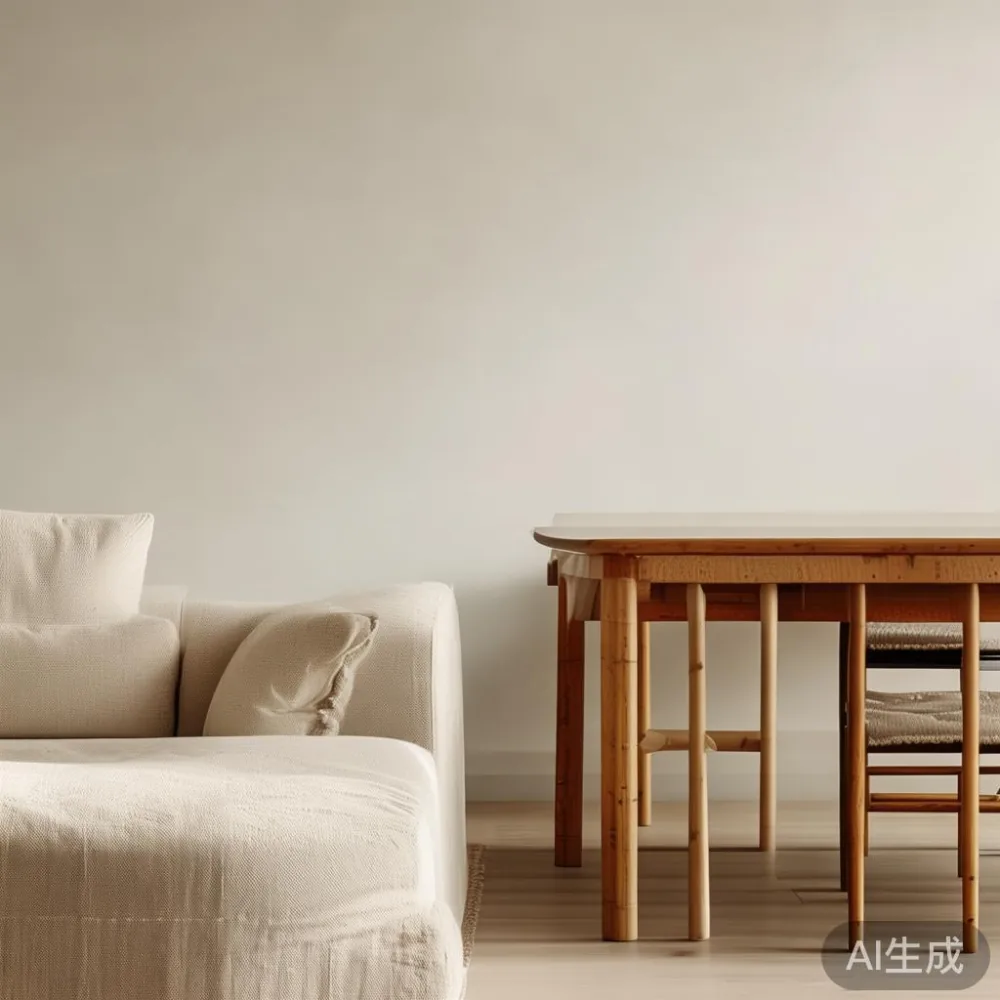
Begin with the dimensions you cannot change. In many HDB flats, the main circulation route between the front door, dining area and kitchen may be only 900-1,100 mm wide. A sofa depth of 850-950 mm can leave too little space if it faces a dining table directly. A dining table around 140-160 cm long may suit four people without dominating a compact kitchen-dining zone, while a 180 cm table is more appropriate for an open-plan condo or a dining room with at least 75 cm of clearance on each seated side.
Use a 3-part rule for every large piece:

1. Proportion: Check the furniture against the ceiling height, door width and room route, not only the empty floor area. Most Singapore HDB ceilings are about 2.6-2.7 m high, so a bed frame taller than roughly 110 cm can look disproportionate unless the mattress is low and the headboard is slim.
2. Tone: Build around one dominant warm neutral and one supporting neutral. For example, oatmeal walls with pale honey bamboo, light oak, warm grey upholstery and matte black details. Keep accent colours in cushions, art and ceramics rather than in multiple large furniture pieces.
3. Utility: Every object needs a job. A nightstand should hold a lamp, charger and glass of water within 45-60 cm of the bed. A dining table should allow 55-60 cm per person. A wardrobe should open without colliding with a door or block a corridor.
A warm minimal room is also easy to over-style. Limit the visible objects on any open surface to roughly 3-5 groups. This creates the composed appearance associated with French light luxury and American light luxury, where generous space, fine materials and restrained ornament are more convincing than excessive decoration.
Which bamboo furniture should anchor the room?
Bamboo furniture is most effective as a structural anchor rather than a collection of small decorative accents. Its straight grain and warm finish can connect a dining table, bed frame or storage furniture without introducing heavy patterns. Choose pieces with uncomplicated silhouettes and consistent joinery, then vary texture through textiles.
In a living room, a solid wood sofa with a pale oak or light ash frame creates a calm base for cushions in sand, taupe and muted olive. A slim-frame bamboo coffee table can bridge the sofa and a woven rug, but it should sit about 35-45 cm from the sofa edge. For a 220-240 cm sofa, a coffee table around 100-120 cm long is usually balanced; anything under 80 cm may feel undersized in a generous condo, while one over 140 cm can restrict movement.
For dining, a bamboo dining table around 150 x 85 cm or 160 x 90 cm gives four diners about 55-60 cm of width each. Allow 90 cm from the table edge to a wall for chair removal and server movement. In a tight HDB dining area, a round 110-120 cm table can work better because it avoids trapped corners, although four seated diners may feel snug at the smaller end of that range.
In the bedroom, a bamboo bed frame with a low profile and a 30-40 cm headboard gives warmth without creating a visual wall. Mattress heights of 22-28 cm often suit this restrained look. A bamboo nightstand measuring 40-50 cm wide and 35-45 cm high should align closely with the mattress top, usually within 5-10 cm, so the bed appears composed rather than assembled from unrelated pieces.
For storage, a bamboo wardrobe or a hybrid timber wardrobe with restrained doors can soften a bedroom. Allow at least 60 cm in front of hinged doors and 90 cm in front of drawers. Make sure the door swing does not meet the lift landing, corridor railing or neighbouring flat door. In Singapore, moisture control is also important: leave 3-5 cm behind movable furniture where possible, use ventilation, and wipe bamboo or solid wood surfaces promptly after splashes.
One caution: real bamboo is not visually identical to laminated bamboo, and material names can be confusing. Ask for the core material, finish, expected indoor humidity range and care instructions. A responsible supplier should distinguish solid timber, bamboo laminated components and engineered board rather than using one broad label.
How do I match a solid wood sofa to bamboo accents?
Start by deciding whether bamboo is the dominant material or the supporting material. In a smaller HDB living room, let the sofa dominate and use bamboo only at the edges: a side table, a narrow console or a frame with visible bamboo details. This keeps the room from becoming visually busy and protects the sofa’s comfort.
Colour matching should happen at two levels. Under daylight, compare the sofa frame, floor and bamboo pieces together. Under warm LED light at approximately 2700 K, check the tones again. Extremely pale yellow bamboo next to a cooler white sofa can expose a mismatch that disappears in morning sun.
For upholstery, warm minimal schemes work particularly well with boucle, linen-blend or lightly textured cotton in ivory, oatmeal or warm grey. A light-oak solid wood sofa with cream cushions feels more relaxed; a dark-walnut frame with black upholstery feels more formal and post-modern. In a Bedok condo with wide glazing and pale terrazzo, a light oak frame can reduce the hard glare often created by stone and glass.
Keep the coffee table visually quiet. A low rectangular bamboo or timber table around 100 x 55 cm pairs well with a straight three-seat sofa. Round edges are helpful in a family home because they soften movement through the space. If the room is only 3.2 x 3.8 m, an oversized sectional may make circulation worse; a 190-210 cm sofa usually offers a better balance, and a slim 30-35 cm side table preserves a 75-90 cm passage.
Styling should involve only a few repeats. For example, carry one colour from the cushions into the dining space, and repeat a material finish in two, not four, visible pieces. This kind of visual continuity is central to post-modern light luxury, where old and new forms are blended through proportion and material rather than strict period reproduction.
When comparing two upholstered forms, the question of a French sofa vs Italian light luxury sofa is less about national labels than depth, profile and finish. A French-inspired sofa often has a softer, more relaxed silhouette; an Italian light-luxury sofa may use sharper geometry and polished detailing. Against bamboo, select whichever profile feels calm from across the room, with no more than 2-3 decorative cushions on a compact sofa.
Which bed frame suits the rest of the interior?
The bed usually occupies the most visible wall in a bedroom, so its frame establishes the room’s material language. Low timber platforms support a warm minimal look; slatted or gently panelled heads add rhythm without excessive carving. A light oak bed beside a warm plaster wall creates a soft transition, while a darker walnut frame requires stronger contrast and brighter lighting.
For a 12 m² HDB bedroom, a queen mattress at 152 x 190 cm generally needs a frame close to 160 x 200 cm, plus 5-10 cm on each side for bedside access. Where a fitted wardrobe runs along the opposite wall, this side clearance may not be possible. In that case, a wall-adjacent bed, a 140 x 200 cm frame or a slim wall-mounted nightstand can preserve circulation.
When examining Japanese bed vs Mid-century modern bed, Japanese-inspired restraint usually emphasises low lines, simplicity and a calm relationship with the wall. A Mid-century modern bed tends to show more pronounced tapered legs, shaped supports or geometric detailing. Both can work in warm minimalism; the room should not contain a Japanese platform, mid-century sideboard and ornate French-style pieces all at once.
The question of is Mid-century modern bed worth it is most useful in a compact bedroom, where the frame’s legs and open under-bed space can create lightness. It is less persuasive if the mattress sits high, the floor is uneven or storage must fit beneath. A quality frame with stable joints and adequate clearance is more practical than chasing a label.
Similarly, European light luxury bed vs Mid-century modern bed comes down to visual weight. European light luxury often leans towards upholstered softness, gentle curves and a more enveloping shape; mid-century styling emphasises structure and exposed form. With bamboo furniture, a simpler timber frame often integrates more naturally.
For practical guidance on how to style European bed in bedroom, use one upholstered headboard, two restrained bedside surfaces, a lamp on each side if space permits, and curtains that reach close to the floor. Keep the bedding palette to 2 main neutrals and 1 accent. A 2-3 m rug width under the bed can visually anchor the frame; a very small rug placed entirely on the floor may look disconnected.
How should dining tables and marble tables relate to bamboo?
A bamboo dining table brings a light grain and warm tone to the centre of the home. It works best when the chairs repeat one of its tones or use a clear material, such as black metal or pale upholstered seats. Avoid placing a very cold, highly reflective table beside warm bamboo unless the contrast is intentional.
For daily dining, check extension mechanisms and storage. A fixed 160 cm table may seat 4 people comfortably and 6 people closely. A 200-220 cm extendable table can seat 6 with better spacing, but its stored and extended footprint should both be measured. Leave at least 90 cm behind occupied chairs for service, or 75 cm if the route is secondary and no cabinet doors open there.
A marble table is usually better treated as an accent. A small round honed-marble side table beside a solid wood sofa can introduce French light luxury through mineral texture and a substantial silhouette. It also works well as a lamp table in a bedroom. Keep the marble top clear or place only one small object on it; several accessories would interrupt the clean surface that makes stone feel luxurious.
Do not assume marble and bamboo create a temperature conflict. Warm bamboo, cream stone and matte metal often form a balanced trio. The real issue is finish intensity. High-gloss marble with lacquered surfaces may feel too formal, while honed marble, brushed brass and natural timber create a quieter residential atmosphere.
For a condo dining room adjoining the kitchen, an extendable bamboo table should preserve a 100-110 cm route when closed and be checked in its fully extended position. A lift with a 900 mm door and a 1,400 mm deep car may accommodate a boxed table, but the packaging dimensions need confirmation before ordering. Smaller flat-pack modules can be a better fit than one heavy carton.
How do wardrobes and nightstands keep the bedroom warm and uncluttered?
Storage is where warm minimal interiors often fail: an open rail of shirts, mixed boxes and dangling cables create more visual noise than the furniture itself. A fitted wardrobe should use a limited internal system—hanging space, 2-3 drawers, a shelf and perhaps a pull-out tray—rather than every possible fitting. In humid conditions, ventilation gaps and moisture-resistant finishes deserve attention.
Warm-toned bamboo wardrobe fronts can reduce the clinical effect of a full-height white cabinet. Use long vertical pulls or recessed handles to keep the surface calm. If the doors are hinged, confirm the swing against neighbouring walls and open windows. For sliding doors, allow 30-40 cm of floor depth for the system and ensure the panels can be serviced.
Nightstands should support the bed rather than compete with it. A 40 x 40 cm square top is practical for a lamp, phone and water glass; 30 x 35 cm may suit a very tight HDB bedroom. Choose drawers that open fully without meeting the mattress or wall, and consider a cable opening at the back. Matching bamboo nightstands on both sides of a queen bed create symmetry, but one wider unit may be more practical in a narrow room.
For the finish, aim for a visual gradient from floor to bed to wall. Pale bamboo against warm beige walls can disappear without texture or shadow, so introduce a slightly deeper oak tone, a woven lampshade or a darker rug. Contrast does not need to be dramatic. A difference of roughly 20-30% in tone is often enough to define shapes without making the room look patchy.
What should I check before delivery to a flat or condo?
Measure the complete route, not just the room. For a high-rise condo, check the parking bay, lift lobby, lift car dimensions, landing and front door. For an HDB flat, include the staircase, void, corridor turning points and letterbox area. The lift door may be 800-900 mm wide, while a furniture package can exceed either dimension. Ask for the packaged width, height and depth of each item and whether it can be separated into modules.
Most Singapore deliveries take 7-14 working days after order confirmation, but lead times can vary by finish and stock status. A precise 14-day return window offers time to inspect the furniture at home. Check the surface under daylight and warm light, test every drawer and door, confirm dimensions, and photograph the packaging before assembly. If a piece arrives damaged, document it immediately rather than leaving the packaging unattended.
Also verify the electrical and practical requirements of lamps and charging points. Place nightstand lamps so their cords do not cross a walking route. For dining seating, allow 55-60 cm per person; for a bedroom passage, aim for 75-90 cm; and in a main corridor, keep the clear width above 900 mm where possible.
MIDHILL’s 10-year structural warranty is useful for long-term confidence, while lifetime refinishing gives solid timber surfaces a route back to an even appearance when small marks, fading or changes in sheen occur. The exact warranty and refinishing scope should be confirmed for the product purchased rather than assumed for every component.
How can I build a warm minimal look without overspending?
Begin with one anchor piece that has strong proportions and daily value: a solid wood sofa, bed frame or dining table. Add bamboo furniture as a secondary layer, choosing the pieces you touch or use most—nightstands, a coffee table, a narrow console or selected storage elements. This approach gives the room a clear hierarchy and avoids paying for coordinated matching that may not be needed.
Budget by category rather than by a single room total. For example, allow S$1,800-S$3,500 for a quality three-seat solid wood sofa, S$900-S$2,000 for a timber or bamboo bed frame, and S$700-S$1,800 for a four-seat dining table, depending on size, finish and construction. A smaller marble side table may be around S$600-S$1,400. These ranges are planning figures rather than fixed prices; request a current quotation before purchase.
Singapore customers should include GST in the displayed budget where applicable and account for delivery. Free shipping applies over US$350 on MIDHILL’s international offer terms, but the relevant local delivery charge should be confirmed for the destination and item size. For bulky furniture, the real cost is sometimes not the base price but access, lifting and assembly.
Light-luxury design also means editing. If you are searching for best light luxury furniture, judge comfort, material honesty, proportion and service rather than ornament alone. A warm minimal room should still feel lived in: add a 160 x 230 cm rug, two or three cushions, a lamp with a warm 2700 K bulb, one artwork and a ceramic vessel. Keep books closed or neatly aligned rather than spread across every surface.
Last month, I visited a friend’s new three-room HDB flat in Tampines with a living area of roughly 3.4 x 3.6 m. We tested a 220 cm solid wood sofa with an 8 cm deep seat cushion against a smaller bamboo coffee table. The sofa felt comfortable, but the coffee table narrowed the front route and made reaching the balcony door awkward. Replacing it with a 100 x 50 cm bamboo table with rounded corners restored a clearer path and created better balance. That experience reinforced a simple rule: in Singapore homes, circulation is part of the composition.
Warm minimalism works when the room feels spacious enough to move, material enough to touch and specific enough to use every day. Bamboo furniture contributes grain, warmth and a lighter visual footprint, while solid timber provides stability and lasting repairability. Start with measured clearances, repeat one material tone and choose furniture by its role in your routine. The resulting home can feel luxurious without depending on decoration alone.